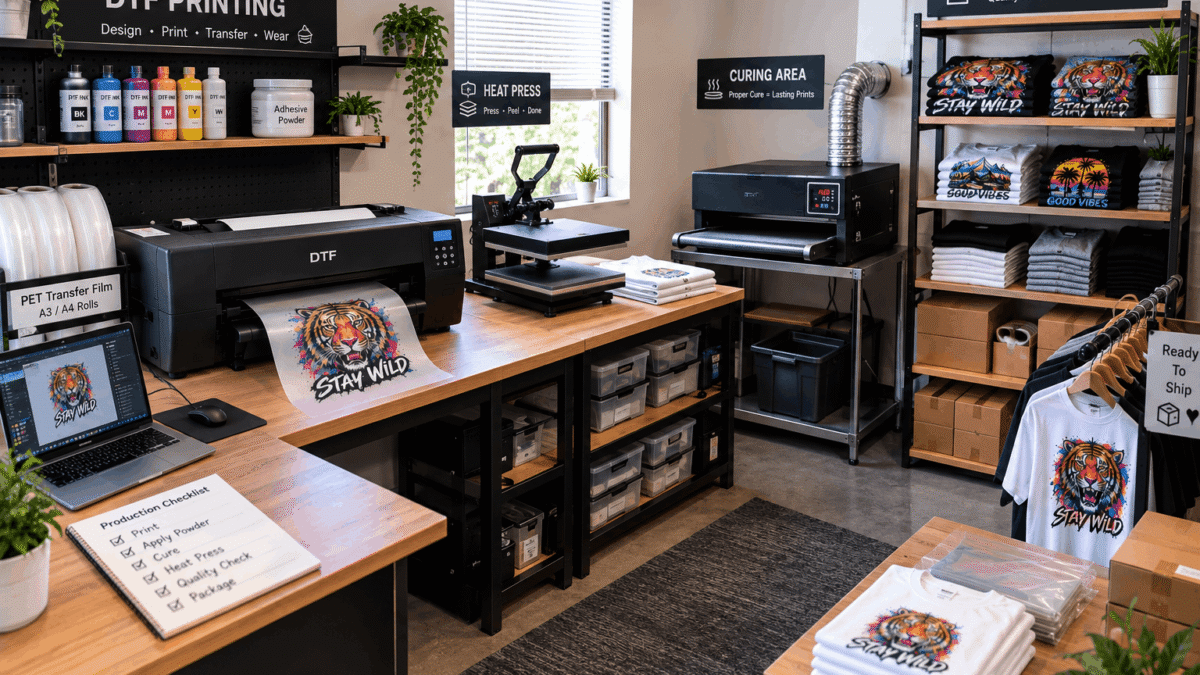
Using a DTF printer for home business production requires more than finding a table for the printer. A practical workspace should accommodate printing, transfer-film handling, adhesive powder, curing, heat pressing, garment storage, maintenance, and finished-order preparation.
The goal is to create a workflow where materials move logically from one stage to the next without unnecessary clutter. Even a compact home workspace can be organized effectively when the equipment, storage, ventilation, electrical needs, and daily workflow are considered before production begins.
Start With the Workflow, Not the Furniture
Before buying shelves or rearranging a room, map the production process.
A typical DTF workflow moves through these stages:
Artwork preparation → printing → powder application → curing → heat pressing → inspection → packaging
Each stage needs enough space for its equipment and materials.
For example, placing blank garments next to the finished-order area can reduce unnecessary movement. Transfer film and printing supplies should remain close to the printer, while packaging materials can be stored closer to the final inspection area.
This simple workflow approach can make a small workspace easier to operate.
How Much Space Does a DTF Printer for Home Business Need?
There is no universal room-size requirement because DTF equipment varies considerably.
Instead of measuring only the printer itself, account for:
- Printer footprint
- Access around the equipment
- Computer or laptop workspace
- Film storage
- Ink and powder storage
- Curing equipment
- Heat press
- Garment storage
- Maintenance supplies
- Finished-product storage
- Safe walking and working space
A compact printer may fit comfortably on a sturdy workbench, but the complete production process can require substantially more room.
The same principle applies to a larger setup. A machine that fits physically may still be impractical if the operator cannot safely access it or move garments and materials around the workspace.
Create Separate Production Zones
A useful home workspace can be divided into simple zones rather than treating the entire room as one work surface.
Printing zone
This is where the DTF printer, computer, transfer film, and relevant ink supplies are handled.
Keep the printer on a stable, level surface and provide enough access for routine maintenance.
Transfer and curing zone
This area is used for adhesive powder and curing. Keep the process organized so transfer materials do not become mixed with clean garments or finished products.
Heat-press zone
The heat press needs a stable work surface and sufficient clearance for operating the machine safely.
Keep garments and prepared transfers within easy reach without creating a crowded working area.
Finishing and packaging zone
After pressing, garments can be inspected, folded, labeled, and packaged here. Separating this area from the printing stage can help keep finished products clean and organized.
Think Carefully About Ventilation
Ventilation is an important consideration in a home printing workspace, particularly where adhesive powder, curing, heat, or other production processes are involved.
The appropriate setup depends on the equipment and materials being used. Follow the manufacturer’s operating instructions and any relevant safety guidance for the specific products.
A dedicated production area with suitable airflow can also make the workspace more comfortable during extended work sessions.
Do not assume that a residential room automatically provides adequate ventilation simply because it has a window. Evaluate the actual process, equipment, and manufacturer’s requirements.
Keep DTF Materials Organized
A small workspace can become difficult to operate when supplies are stored randomly.
Use clearly designated storage for:
- PET transfer film
- DTF inks
- Adhesive powder
- Cleaning and maintenance supplies
- Blank T-shirts
- Finished garments
- Packaging materials
- Spare production supplies
Transfer film should be protected from conditions that could affect its handling or performance. Ink should be stored according to the manufacturer’s instructions, while powders and other consumables should remain properly contained.
Simple labels can make it easier to identify supplies without opening multiple containers.
Electrical Planning Matters
A home DTF workspace may contain several powered devices, including a printer, computer, heat press, curing equipment, and lighting.
Avoid designing the workspace around a collection of overloaded extension cords or inconvenient power connections.
Before installation, identify the electrical requirements of each machine and follow the manufacturer’s specifications. If you are unsure whether the available electrical system can safely support the equipment, consult a qualified professional.
Keeping cables organized also reduces clutter and makes maintenance easier.
Make Maintenance Part of the Layout
Printer maintenance should not be an afterthought.
Leave enough space to access the printer for routine cleaning, inspection, ink-related tasks, and other maintenance procedures specified by the manufacturer.
Store maintenance supplies in a dedicated location rather than placing them wherever there is temporary free space.
A well-planned workspace makes regular maintenance easier because the required supplies and access points are already part of the setup.
Choose the Right Equipment for Your Available Space
The physical size of a machine is only one part of the decision.
When evaluating a DTF printer for a home business, consider its footprint, operating clearance, maintenance access, production capacity, consumable requirements, and how it fits into the complete workflow.
A printer that appears compact in a product listing may still require additional room for film handling, heat pressing, curing, storage, and operator movement.
Think about the complete system before deciding where the printer will go.
Plan for Clean and Finished Garments
Blank garments and completed products should have their own storage areas.
Keeping clean garments away from powder, ink, and other production materials helps maintain an organized workflow. Finished shirts should also have a dedicated location before packaging or delivery.
This becomes increasingly important as order volume grows. A pile of finished garments on the same surface used for printing can quickly turn a small workspace into a difficult production environment.
What If the Workspace Is Very Small?
A limited room does not necessarily prevent home-based DTF production, but it does require careful planning.
Consider vertical storage, compact work surfaces, mobile tables, and clearly defined production zones. Avoid filling every available area with equipment. The operator still needs safe movement and access for maintenance.
It can also help to keep only frequently used supplies near the production area while storing backup inventory elsewhere.
Build the Workspace Around Your Real Business
The best home DTF workspace is not necessarily the largest one. It is the one that allows the production process to move logically from digital artwork to finished apparel while keeping equipment, materials, maintenance, and safety requirements manageable.
Start by mapping the workflow, measure the available space, identify equipment requirements, and then assign each stage a practical location. As the business grows, the workspace can evolve with the equipment and order volume rather than requiring a complete redesign from the beginning.