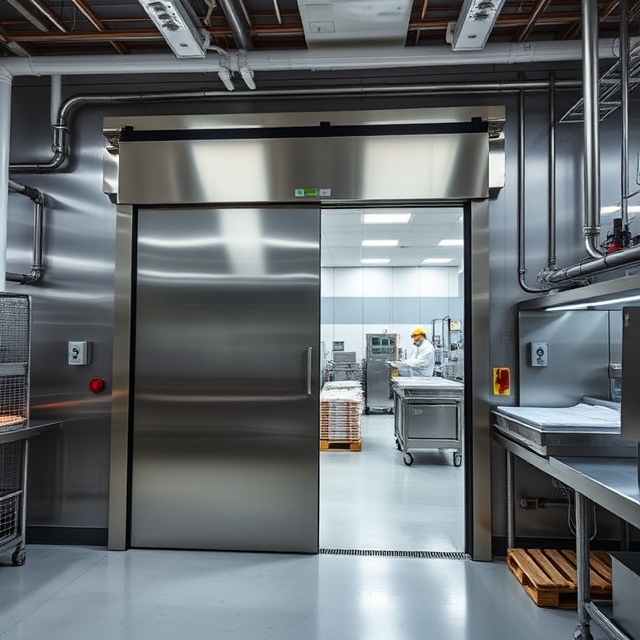
Food processing cold storage doors are an important part of facilities that handle chilled, frozen, or temperature-sensitive products. These doors must do more than separate two rooms. They need to support temperature control, hygiene, frequent movement, safe access, and practical cleaning routines.
Because food-processing environments can involve regular personnel movement, pallet handling, washdown procedures, and significant temperature differences between rooms, door selection should be based on the complete operating environment rather than appearance alone.
Why Food Processing Cold Storage Doors Matter
A cold-storage doorway creates a boundary between areas with different temperatures and operating conditions. Every time the door opens, warmer ambient air can enter the refrigerated space while cold air escapes.
A suitable door helps limit this exchange through insulation and effective sealing. The result is a more controlled separation between processing areas, cold rooms, freezers, and other temperature-managed spaces.
However, temperature performance is only one consideration. Food-processing facilities also need surfaces, hardware, and layouts that can support routine sanitation and minimize places where moisture or residue can accumulate.
Hygiene Should Be Part of the Door Specification
In food-processing areas, a door should be easy to inspect and clean. Smooth, durable surfaces are generally easier to maintain than complicated assemblies with unnecessary recesses or exposed areas where debris can collect.
Stainless steel is commonly considered for demanding food environments because it provides a durable, cleanable surface and can resist corrosion when properly specified for the operating conditions.
The door design should also be evaluated around:
- Door-panel surfaces
- Frames and edges
- Sealing gaskets
- Handles and operating hardware
- Tracks and guides
- Threshold areas
- Joints and connection points
The goal is to create an access system that fits naturally into the facility’s sanitation routine rather than becoming an obstacle to it.
Temperature Control Depends on More Than the Door Panel
A well-insulated door panel can help reduce heat transfer, but the complete doorway matters. Gaps around the frame, damaged seals, poor installation, or excessive opening time can reduce the effectiveness of the overall barrier.
For that reason, facilities should consider insulation together with perimeter sealing and the way the door is operated.
For example, a freezer entrance with frequent forklift traffic may need a different configuration from a small cold room that is opened only occasionally. The required insulation level, sealing arrangement, opening method, and hardware should reflect the actual temperature and traffic conditions.
Consider Traffic Before Choosing the Opening Method
Food-processing facilities can have very different traffic patterns. Some doorways mainly serve employees, while others are used repeatedly by pallet trucks, forklifts, carts, or product-handling equipment.
A sliding configuration can be useful where the available floor area makes a swinging door inconvenient. It allows the door panel to move horizontally rather than occupying the passage area during opening.
For larger or frequently used openings, facilities can also investigate automated or high-speed configurations where appropriate. The selection should consider cycle frequency, opening dimensions, safety requirements, available space, and the need to maintain temperature separation.
When evaluating cold storage door solutions for a food-processing facility, these operating conditions should be discussed with the door supplier before the final specification is selected.
Sealing and Condensation Deserve Attention
Temperature differences between a refrigerated room and a warmer processing area can contribute to condensation around poorly sealed or thermally weak doorways.
Moisture can become particularly troublesome when it remains around frames, thresholds, seals, or other components. Therefore, the door assembly should be assessed as a complete system.
A practical inspection should ask:
- Does the door close firmly against its seals?
- Are the gaskets intact and correctly positioned?
- Are there visible gaps around the frame?
- Does the door remain aligned during operation?
- Is condensation appearing around the doorway?
- Are tracks and moving components accumulating debris?
Early attention to these issues can help prevent minor door problems from becoming operational disruptions.
Match the Door to the Processing Environment
Not every food-processing area has the same requirements. A dairy processing room, frozen-food warehouse, meat-processing area, and refrigerated distribution zone may have different temperatures, cleaning practices, traffic levels, and opening dimensions.
The specification process should therefore consider:
Temperature
Identify whether the doorway serves a chilled room, freezer, blast-freezing area, or another controlled-temperature zone.
Traffic
Estimate how often people, carts, pallet equipment, or forklifts will pass through the opening.
Hygiene
Determine how frequently the area is cleaned and whether the door will be exposed to moisture, detergents, or washdown procedures.
Space
Check whether there is enough side, overhead, and floor clearance for the proposed opening mechanism.
Safety
Consider emergency release, sensors, visibility, operator access, and protection against accidental contact with moving equipment.
A Practical Selection Approach
Start by documenting the doorway’s actual operating conditions. Record the room temperatures, opening dimensions, traffic pattern, cleaning routine, and available space.
Next, determine what the door needs to accomplish. In one location, thermal separation may be the primary concern. In another, hygiene and frequent material movement may have equal importance.
Finally, review the complete door assembly rather than focusing only on the panel. Insulation, seals, frame construction, hardware, operating method, safety features, and maintenance access all contribute to the long-term performance of the doorway.
Common Questions About Food Processing Cold Storage Doors
What type of door is suitable for a food-processing cold room?
The appropriate type depends on temperature, traffic, opening size, hygiene requirements, available space, and operating frequency. Sliding, hinged, automatic, and high-speed configurations can each serve different applications.
Why is sealing important in food-processing cold rooms?
Effective sealing helps limit unwanted air exchange between areas with different temperatures. It can also reduce the conditions that contribute to condensation around the doorway.
Are sliding doors useful in food-processing facilities?
They can be useful where side-to-side opening is more practical than a swinging door, particularly when floor space or traffic flow makes a conventional hinged arrangement less convenient.
What should be checked during maintenance?
Inspect seals, tracks, rollers, frames, hardware, sensors, and door alignment. Cleaning and inspection schedules should also reflect the facility’s sanitation requirements and operating conditions.
A food-processing cold-storage door should be selected as part of the facility’s overall temperature-control, hygiene, and material-handling strategy. When insulation, sealing, cleanability, traffic, safety, and maintenance are considered together, the doorway can better support both daily production and controlled storage operations.